
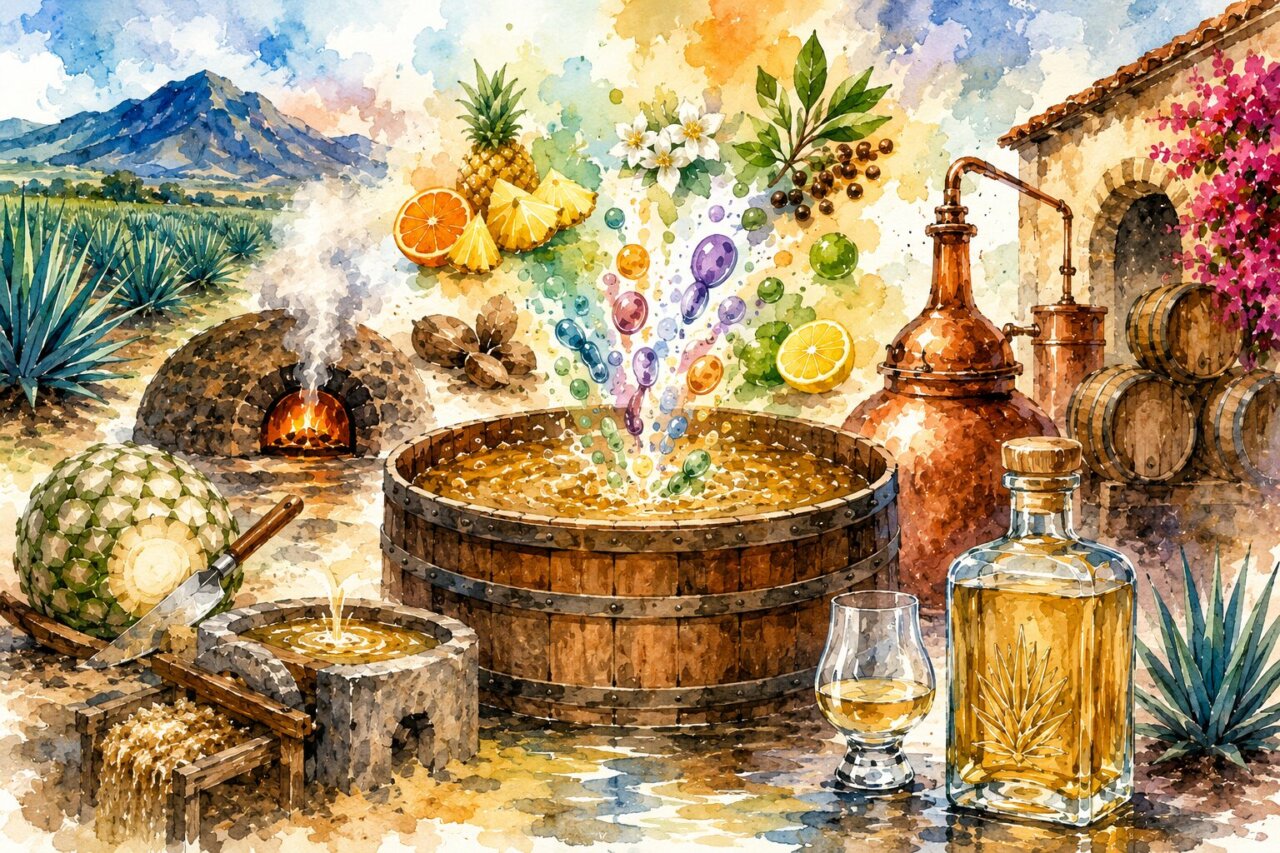
Ask ten tequila makers where flavor is truly born, and you may get ten different answers. Some will insist it begins in the agave fields. Others will point to slow cooking, tahona crushing, copper stills, or barrel aging. Yet in recent years, one stage has moved to the center of serious tequila discussions: fermentation.
And science suggests there is good reason for that.
Fermentation is the moment when sweet agave juice comes alive with chemistry. Yeasts and bacteria consume sugars and create alcohol, but they also generate hundreds of volatile compounds responsible for aroma and flavor. Fruity esters, earthy notes, floral tones, spice, brine, tropical fruit, olive, butter, citrus, herbs. Much of tequila’s character begins here. Researchers studying tequila production describe fermentation as one of the most critical stages because it transforms sugars not only into ethanol, but also into flavor-active compounds that define the spirit’s aromatic identity.
That does not mean fermentation acts alone. Tequila flavor develops like a chain reaction. Agave quality, terroir, cooking methods, milling, fermentation, distillation, water, and aging all shape the final spirit. Yet fermentation may be the stage where the greatest range of flavor possibilities first emerges.
Think of it this way: cooked agave provides the raw material, but fermentation decides what to do with it.
The microorganisms involved matter enormously. Different yeast strains create entirely different aromatic profiles. Scientific studies on tequila fermentation show that native yeasts can produce very different levels of key aroma compounds, including esters, alcohols, acids, and aldehydes, all of which shape flavor and aroma. Some strains generate bright fruitiness and floral notes, while others push the spirit toward earthy, savory, or spicy characteristics.
This is why two tequilas made from the same species of agave can taste completely different.
Modern industrial tequila producers often rely on commercial yeast strains for consistency and speed. Traditional distilleries may use partial or fully wild fermentation, allowing ambient yeasts and bacteria from the distillery environment to participate naturally. These spontaneous fermentations are usually slower, harder to control, and less predictable, but many tequila enthusiasts believe they produce greater complexity and a stronger sense of place.
Scientific research supports this view. Studies of spontaneous tequila fermentation have observed high microbial diversity and linked these mixed microbial communities to more layered aromatic outcomes. In simple terms, more microbial activity can translate into more dimensions of flavor.
Temperature changes everything as well. Warmer fermentations tend to create more aggressive esters and higher alcohols, while cooler fermentations may preserve softer and cleaner aromas. Oxygen exposure, fermentation time, open-air versus closed tanks, wooden vats versus stainless steel, even the presence of agave fibers inside the fermenter. Every detail subtly reshapes the final character of the spirit.
Even bacteria, often treated as contamination in industrial production, can contribute distinctive notes in traditional tequila and mezcal making. Certain bacteria produce lactic compounds associated with creamy, yogurt-like, buttery, or funky aromas. Excessive bacterial activity can damage efficiency and consistency, but controlled bacterial presence can add remarkable depth.
Still, declaring fermentation the single most important stage may oversimplify tequila.
Without quality agave, fermentation has little to work with. Poor cooking can destroy sugars or introduce bitterness. Distillation determines which compounds survive into the bottle. A skilled distiller makes countless decisions about cuts, proof, and still operation that shape texture and aroma. Barrel aging can further transform tequila through vanilla, caramel, spice, and oak extraction.
In reality, tequila flavor resembles an orchestra more than a solo performance.
Yet fermentation may be the conductor.
It is the stage where invisible biology transforms agricultural sugars into a spirit with personality. It is where tequila begins to develop individuality. Increasingly, many tequila experts see fermentation not merely as alcohol production, but as the true birthplace of flavor complexity.
Perhaps that explains why some of the world’s most admired artisanal tequilas speak less about efficiency and more about yeast, time, open-air tanks, and living fermentation.
Because long before tequila reaches the barrel or the bottle, its flavor story is already being written inside the fermenter.


